
Updated: 27-11-2026;
There is indeed a version of the article that begins with a definition of peptides and a very nice overview of the importance of purity. Have you read this article? It didn’t tell you much.
But let’s begin with the problem at hand.
Experiment. The outcomes are bizarre! Not off… off.Not off… off. Inconsistent across replicates. You troubleshoot the protocol, equipment, cell line.
Everything checks out. A peptide batch itself is suggested to be tested after 3 weeks. It was discovered that the purity was 88% and not 95% as stated on the label.
The CoA was real. But the chromatogram on the backside had a different story.
That is a situation that occurs more frequently than one is published on.
The number on the label is not the answer, but a starting point.
95% Pure Sounds Good. Typically it is – for Routine Jobs.
However, that 5% is nothing. It’s something. Deletion sequences (due to incomplete synthesis), oxidised side chains, residual solvents, related peptides that co-elute under certain conditions.
That 5% will likely not sink that ship for most cell-based assays. If it’s dose-sensitive, receptor-binding, or heading into the regulatory process, it’s important to know what you’re dealing with.
The percentage of purity provides you with a signal. It doesn’t give you the full picture.
When Using HPLC: Do Not Just Read the Number; Examine the Chromatogram.
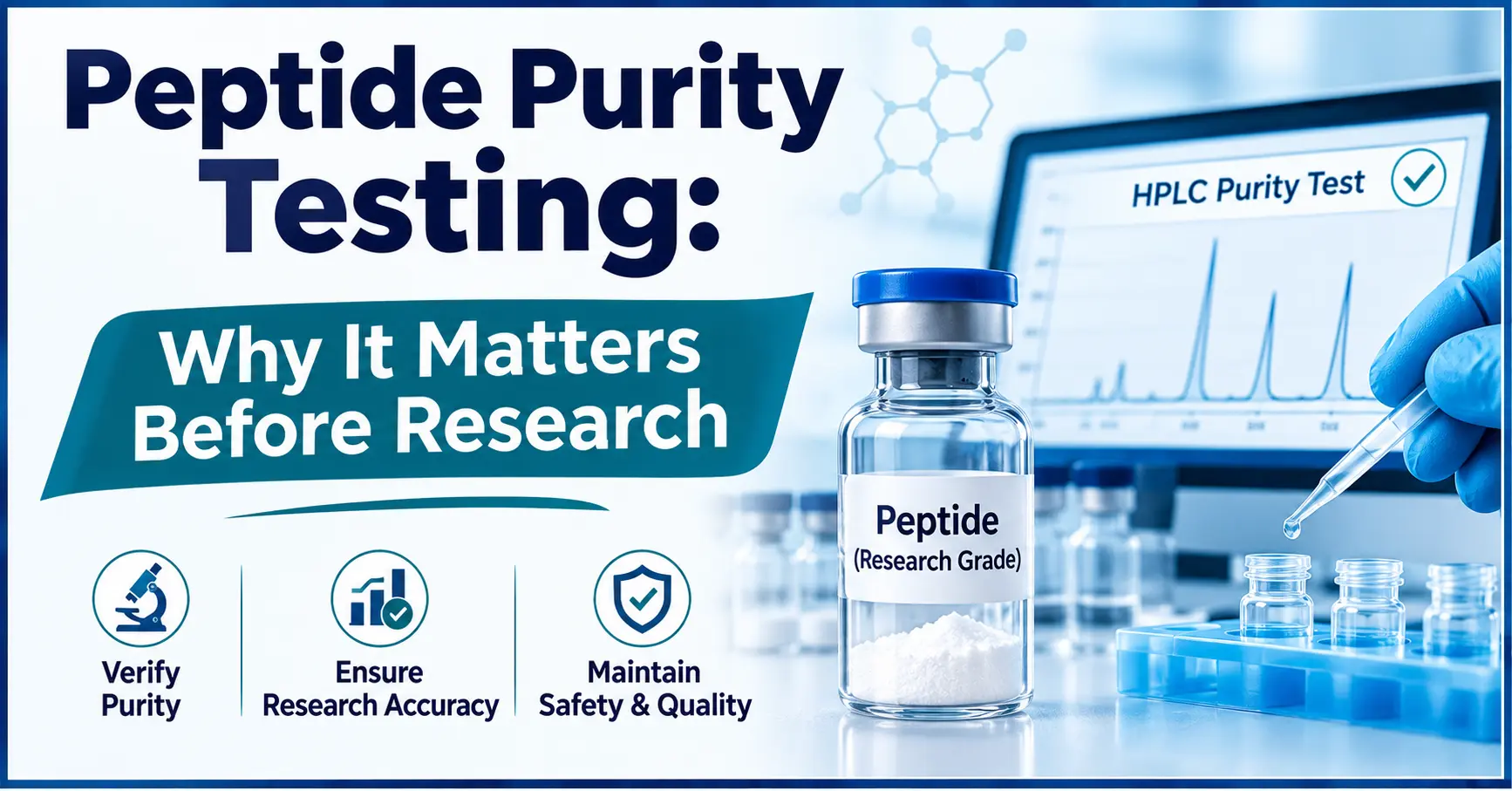
The standard for the moment is still reverse-phase HPLC. Sorts out your peptide components by hydrophobicity and provides a chromatogram, which is a graph illustrating not only the most prominent peak but everything else in the sample.
Most researchers simply ignore the percentage of purity shown on the CoA. Understandable; it’s quicker. However, the chromatogram is more informative. In a clean sample, there is a sharp, well-resolved peak.
A satisfactory, acceptable-looking 95% purity could have a high baseline that is not as quiet as it should be, or a small shoulder indicating a related impurity.
The actual trace will take about 30 seconds to look at. Worth doing.
Mass Spec: Identity is Different from Purity
This is a difference that needs to be broken down more than it is.
HPLC gives you the composition of your sample and tells you how much of the major compound is in the sample compared to the other samples.
Mass spectrometry provides you with the correct compound – the actual mass of the dominant compound- so that you can compare it with the theoretical mass of your peptide (and determine if they do match).
You need both. An unexpected modification or synthesis error can result in a peptide being synthesised with the incorrect mass and still pass HPLC purity levels. Similarly, the confirmation of MS does not provide any information about the percentage of the impurity fraction.
Research peptides are generally treated using ESI-MS, which is fairly mild and works over a fairly large mass range.
The calculated molecular weight of the observed and the theoretical should agree within the tolerance of the instrument. Otherwise, that’s a discussion to have with your supplier before you begin the experiment, not after.
On CoAs and Who is a Producer
Get this straight – a CoA that the supplier produces is not equivalent to a CoA that is produced by an independent analytical lab.
This is not an accusation; it’s simply an observation of the structure. This is because the same company that sells you the peptide also does the QC analysis and prepares the report.
This is because there is a conflict of interest since the same company that sells you the peptide also does the QC analysis and prepares the report. This is not to say that the data is incorrect.
It means that you are taking their word for it, unlike an independent third-party analysis.
Independent Documentation trumps for research that may be submitted to regulatory authorities, clinical practice, or anything that you need to justify your ways.
Before using the material, researchers can check for purity and identity on an independent third-party tested report that Zybiopeps offers with every order.
The Part After the CoA Was Written: Storage
Peptides can be shipped at 98% purity and end up with a compromised function. It doesn’t happen all the time, but it happens.
Under conditions of proper storage (usually dry, −20°C, and out of light), lyophilised peptides remain stable. Risk of degradation arises from repeated freeze/thaw cycles, humidity at the time of reconstitution, or an inadequate cold chain in shipment.
Reconstitution is a variable not included. Some of these things will impact on the appearance of your peptide when it reaches the assay — using the wrong solvent, allowing your working solution to sit up to several days at 4°C, vortexing too hard.
This is not reflected on the CoA. The CoA is a representation of the peptide at the time of the test, under the supplier’s conditions. The thing you are working on in your lab is after that.
The Things to Look for Before You Begin
Not a checklist, just the things to make sure you’re checking:
- HPLC purity of ≥ your threshold for the application and chromatogram reviewed directly.
- Molecular identity by MS data.
- CoA source, preferably outside the company and if from a named analytical lab, it should be a laboratory other than the one that prepared the QC sample.
- Confirmed storage conditions from dispatch to freezer.
- Reconstitution protocol according to the supplier’s recommendations.
- Number of Freeze-Thaw Cycles Monitored.
This is not an imposition. Checking takes less time than you would be spending in troubleshooting if you didn’t check.
The Supplier Decision, Which Impacts All Areas Downstream.
Peptide sourcing is among those procurement choices that are made rapidly and have a significant impact. The price difference between suppliers often isn’t that large. There may be a considerable quality gap.
The real question when evaluating a vendor: do they include CoA’s for each batch or is it something they do on an ad hoc basis?
Is HPLC/MS data included? Will they let you know where they did their QC? Do they answer your technical questions or back you to a salesperson?
A supplier that takes quality documentation for granted is not a supplier to work with in the long term.
One Last Thing
Quality verification of peptides is not difficult. The techniques are known, the goals are realistic, the equipment is available.
What it needs is to be part of the routine you use when you source peptides; make sure they’re part of your routine, and not after the data doesn’t make sense anymore.
The best you can get is determined by what you start with. This is true for all aspects of experimental science, and peptides are no different.
See before using. Every time.