




Updated: 13-09-2026 ; Author :
When most of us think of pharmaceutical, clinical science, or biology work, we instantly picture the “great scientist” who lives and breathes science 24/7.
This blog post explains: Pharmaceutical Cold Storage Skills: What Pharma Professionals Need to Know
A laboratory setting with a white-coated protagonist isn’t enough to paint the perfect scene: we want to see them with magnifying glasses over their eyes, peering into microscopes, and moving a pipette with the precision of a robotic hand.
However, talking on the phone in front of a propped-open freezer is an easy but extremely dangerous way to destroy months of research.
It’s hardly exciting; nevertheless, keeping equipment cold is the foundation of pharma as it is today. One freezer breakdown may mean you lose precious vaccines, trial samples, or reagents.
Biological materials, diagnostic test items, samples of various kinds, and even vaccines require being stored and handled within a narrow range of temperatures.
So, every laboratory also has personnel dedicated to maintaining refrigerated conditions, knowing what to do to get everything sorted out if things start to go wrong, and also being capable of providing paper-based documentary proof that the processes have gone correctly.
We are taking a peek at this unnoticed aspect of lab operations.
The deep expertise in machines, the strict documentation work, the monitoring abilities, and other quiet support systems are exactly the kind of skills that employers look for when hiring these days.
Reality Check
Pharmaceutical work nowadays is not solely about biology and chemistry, because these companies use such precise temperature monitoring as one of the biggest tools to their advantage in the market.
Keeping paper records of your activities is the job: You may dislike it, but the truth is that logging data and material tracking are not just extra duties but major parts of the job.
Having good skills concerning machines can lead to an interview: Your ability to analyse logs of alerts from storage units or to solve storage problems will be an excellent selling point.
You are the one responsible for equipment functioning: In an environment that is heavily supervised, it is not enough for you to know how to perform an assay; you have to grasp how the equipment works.
You can always find a place: Procedural discipline and monitoring experience can easily transfer between pharma, clinical trials, and hospitals.
What No One Tells You About Lab Work
A typical Tuesday at a pharmaceutical lab has nothing to do with science experiments you see in movies.
There are times when amazing experiments are conducted; yet, you will probably spend most of the time doing very basic routine tasks that include moving materials from one stage to another while ensuring a level of safety.
Suppose you get a multi-million biologic sample delivered to your warehouse. The first thing after that is to do an inventory and take it for storage according to the instructions and guidelines.
Every time the material is being handed over, it must be accompanied by documentation and records.
The materials will eventually be checked for consistency with the state in which they arrived.
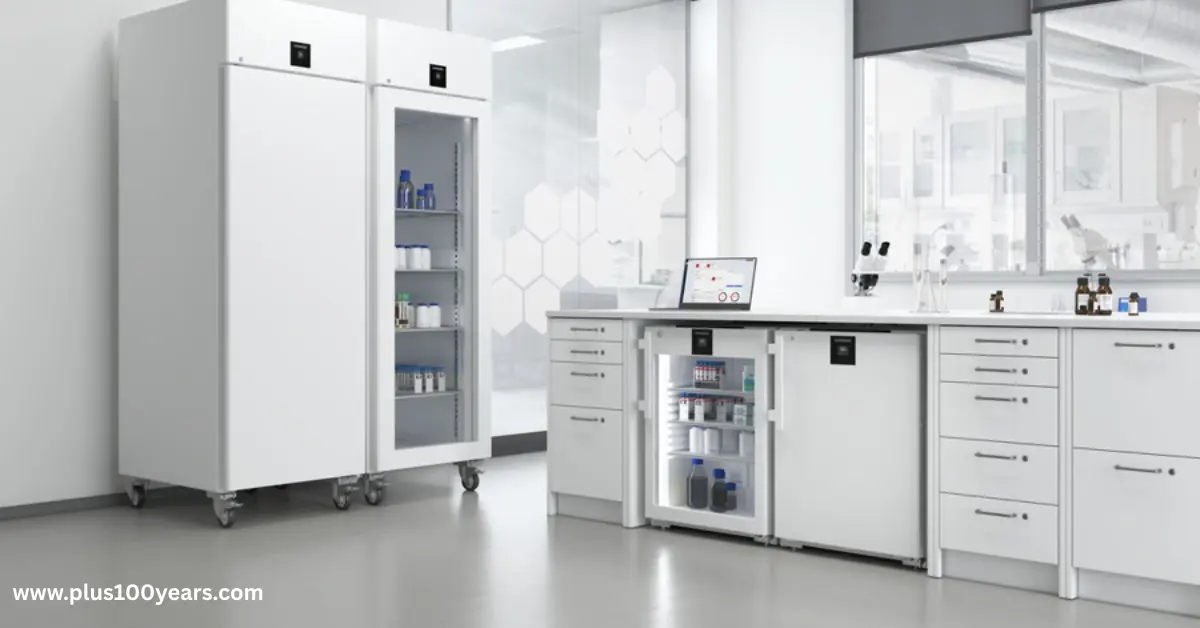
The Hero Behind the Hero: The Lab Fridge
Most advisors will talk about the shiny instruments.
Mass spectrometers and DNA sequencers are the stars of the show because that’s where “the real science” happens.
Yet a much smaller part of the story is about the machines that sustain the lab operation. These should be the main characters of the story.
Storage units, for example, are probably the first things one should be concerned with.
Fridges and ultra-low freeze chambers are indispensable pieces of laboratory equipment that every member of the lab has access to.
One of the most frequent errors of newbies is to see these high-priced pieces of equipment as nothing more than the kitchen fridge they have at home.
To show the huge differences between the two kinds of machines, here is a brief comparison:
| Feature | Your Kitchen Fridge | A Laboratory-Grade Fridge |
| Temperature Range | Swings wildly depending on where food is placed. | Forced-air ensures uniform temp on every shelf. |
| Door Open Recovery | Takes hours to cool back down after being opened. | Recovers within minutes of the door closing. |
| Alarms | Might beep if you leave the door wide open. | Logs continuous data and alerts remote sensors. |
| Purpose | Keeps your leftover takeout safe to eat. | Protects millions of dollars in clinical materials. |
Reliability here really puts a strain on the person.
If a centrifuge breaks down in the middle of the work, one would probably start with the least unpleasant tasks – cursing (if necessary), cleaning up and then repeating the operation, which you will not even be too glad.
It is merely a local irritation. However, what if a fridge is working so slowly and quietly that it gradually changes the temperature it was set to over the course of the weekend?
The moment you come to the site on Monday, you will find out that you have lost several valuable samples.
These situations call for a system of alarms. It should by no means be regarded as something which one can dispense with at one’s whim.
Mere alarm features, however, can not do the job alone. There still needs to be one or some persons who will be responsible and can act upon the alarms accordingly.
The understanding and interpretation of alarm messages and the decision-making are part of what constitutes being a good worker.
One has, first, to determine the level of the set-point for the alarm. Then one has to find out whether or not the alarm condition was due to a malfunction or, perhaps, to other external conditions.
After that, one has to call the person who can take the required actions after the alarms have been activated.
Knowing exactly the places where things should rest will always save you. The storage areas in a typical lab are divided roughly into the following groups:
- General storage: This is just storage at 2°C up to 8°C, for items whose performance is not seriously affected by minor fluctuations and short-term deviations in temperature.
- Sample and reagent storage: The storage conditions are much more demanding here; one has to keep a constant temperature, continuously monitor it and quickly restore it in case of a failure.
- Ultra-Low and Liquid Nitrogen Storage (-80°C to -196°C): These are big and powerful storage systems for the cell stocks that hardly get opened and are meticulously tracked.
The Habit of Keeping Documentation
Then why would such mundane appliances be treated as engines of a jet plane in these settings?
It is not something that is just about doing things correctly or incorrectly. Rather, the point is to show how everything went wrong.
When a fridge in a regulated environment goes beyond the range that is considered “the standard”, you’re in for a very unpleasant and costly predicament if it breaks down or even fails for a short while.
This situation is known as “temperature excursion”, and it will definitely cause a lot of holes in Quality documents that nobody is going to be happy about.
There will be someone looking for a person who, at the least, will be able to tell what was going on and how it happened.
Government regulators like the FDA and quality control units have their own logic and way of seeing things.
You must not expect your quality systems to run all the time flawlessly, but they should spot your imperfections at once. A reliable refrigerator preserves the science, so does a reliable temperature log protect your job.
“If it wasn’t documented, it didn’t happen.”
This is not only an unofficial motto of the pharmaceutical industry but has become a well-established fact to many of its members.
It justifies how the legitimacy of the outcome of a test or any other kind of experiment is being proven.
The main way for the industry to stay on the right side is to abide by a code of rules called the ALCOA+ principles – the industry’s standards for documentation practices.
All the notes that you make about how an item is stored have to be Attributable (we have to know who it was), Legible (we must be able to read it), Contemporaneous (you had to note it down when it was done, not based on an event which happened hours ago and you remembered), Original (it is the record of an actual event), and Accurate.
This combination of precise handling of things and extensive reporting is what characterises a big pharmacy as compared to the more carefree atmosphere of a chemistry class at a university school.
It’s a system that appreciates the ones who find routine and repetition of everyday activities to their liking and are content to do identical safety checks day after day, no matter how good they seem to think things are.
Where These Skills Can Take You
Luxuriously getting proficient in the skill set related to handling equipment and being strictly regulated opens a whole range of different careers that you probably won’t know if you only focus on being a biology or chemistry major.
When your laboratory work is no longer theoretical and when you get the hang of the actual day-to-day life of a lab, your value becomes enormous.
Your possibilities will lead to positions such as the ones which actually are responsible for the science infrastructure:
- Quality Assurance (QA): Instead of running the experiments, you act as a quality auditor. You check the temperature logs, dig deeper into why a freezer was broken, and finally decide if a batch of drugs is safe for people.
- Biobank Management: Biobanks are places where they hold huge numbers of biological samples such as tissue, blood, and DNA for many years.
- Working in a biobank is a bit like graduate school, where everything you do is a master’s level in very low-temperature logistics and managing databases.
- International Supply Chain: When a company organises a global trial with drugs still at the experimental stage, there will be a person at some company who will have to figure out how to get such a product through 40 different countries’ customs, at the same time not allowing the product to go out of the -20°C condition while it is loaded on the ground at the hot weather port of the plane.
Are You the One with the Correct Attitude?
Flourishing in such an environment is a matter of having the right personality.
Persons who have a long and solid career in such fields treat a minor mistake or variation as an intriguing riddle and not an irritation worth ignoring.
They are perfectly comfortable thinking that if you have been able to get the task right in 99 instances, the chance is that the 100th run still needs you to do a second check.
This can be challenging for individuals who would rather engage in a creative process and not focus on a procedure.
However, a mindset is such that if you can understand how to look at a 30-day temperature chart of any sort (you might even prefer to do it on a computer screen without moving), recognise that your compressor is getting worse before it breaks down, and be contented with the little achievements of an audit free of error, then you will always find a new job.
The science aspect just gives you a foothold.
However, a willingness to work with established procedures, the ability to respect a machine and to treat the matter of supplies and materials as if they were equal in importance to the conduct of the experiment? That is what ultimately helps you to establish a career in your field.
Have you given some amount of thought to looking at the Quality Assurance or the Supply Chain sector of scientific work as an alternative to just strict laboratory research?