
Updated: 06-08-2026 ;
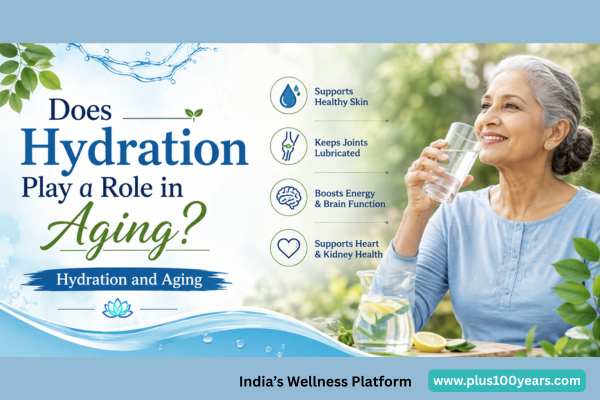
Does Hydration Play a Role in How Fast We Age?
I used to think people become old only because they keep having birthdays.
Every year you cut a cake, your number becomes one bigger, and slowly you turn old. That was my simple idea for a long time.
But this year in school, we studied a little about the body and health, and I started thinking that maybe food, sleep, sunlight, and even drinking water also affect how a person looks and feels as they grow up.
So I chose this question for my article, and I read a lot about it. I was not sure whether this was appropriate for a school essay, but my teacher said it was a nice topic.
The old photo on our wall
There is an old photo in our drawing room from my parents’ wedding. My father had thick black hair, and his face looked very different from now.
Today he has less hair, and some lines appear around his eyes when he smiles. I kept looking at that photo and wondering why he changed so much.
Is it only because many years passed, or did something else also happen slowly without us noticing?
My mother said everyone changes like this. The body gets older by itself, the skin becomes thinner, and it does not come back to shape the way it did before.
I have seen this in my grandmother also; her hands have many more lines now than in her young photos.
That made me curious to know if water has any part in this whole hydration and ageing process, because people keep saying water is good for the skin.
What happens when I forget to drink water
Last month our school grounds were very hot during the games period. I was running and running, and I completely forgot to drink from my bottle.
After some time, my head started aching a little, and I felt tired and cranky.
When I finally drank water and sat down, I felt better for a few minutes. Now I try to keep my bottle near me and sip even when I am busy playing.
That is when I understood what dehydration is.
It is when the body does not have enough water to do its work. Water helps carry food and air in the blood; it helps break down the food we eat, and it helps the body stay cool by making sweat.
When there is less water, all this work becomes slow, so we feel weak, thirsty, and sometimes we cannot concentrate in class.
The NHS and Mayo Clinic explain that tiredness, headache and trouble focusing are common when a person does not drink enough.
These are the kind of dehydration and ageing signs that families should notice in older members, because it can affect them faster than us.
I also read on the National Institute on Ageing website that older adults may not feel thirsty as quickly as young people, even when their body actually needs water. This sounded strange to me.
So an older person can be low on water and still not feel like drinking anything. That is one reason my grandfather says he is fine on a hot day when he should really drink more.
So does water really keep us young?
Now comes my main question. In the beginning, I thought that if a person drinks lots of water, their skin will always stay young and the wrinkles will slowly go away.
I really believed this. But after reading more, I found that it is not fully correct, and I had to change my mind.
Did You Know?
When skin does not get enough water, it can look dry and dull, and the small fine lines can look a bit clearer.
If the same person drinks enough water, the skin looks fresh, and the lines look softer again. This is the part people call hydration skin ageing.
But that fresh look is only for some time, and it does not mean the person became younger inside. Drinking water does not remove wrinkles forever, and it cannot stop or reverse ageing.
The skin needs more hydration and alkaline-based water. Some people call this closeness of skin and water the ageing skin hydration link; still, it does not decide the real ageing of the body.
Our body ages because of many slow changes inside our cells, and water alone cannot control that.
So this is the real difference in the hydration and ageing process. Looking fresh and hydrated is nice and healthy, but it is different from slowing the true ageing that happens as time passes.
So water is helpful, but it is not a magic drink.
There is also this idea that drinking more water makes people live much longer. Some talk about water intake longevity like it is a hidden secret.
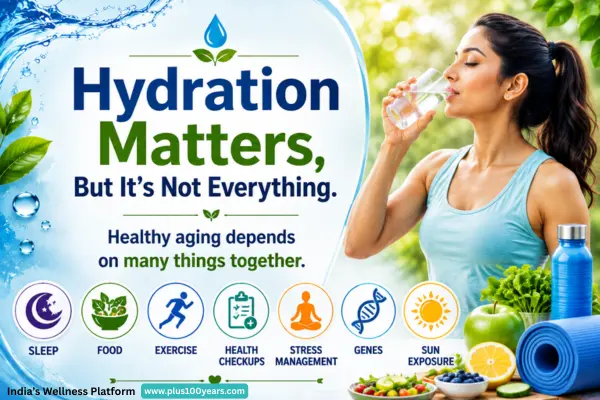
But I could not find any proof that just drinking extra water makes everyone live longer instead of alkaline water, and ageing depends on many things together, like sleep, food, exercise, health checkups, stress, our genes and even how much sun our skin gets over the years.
And more water is not always better, either. My mother told me that people with heart, kidney or liver problems sometimes have to be careful and follow their doctor about how much fluid they drink.
The amount of water a person needs is not one fixed number, either; it changes with the weather, the games we play, our food, our age and the medicines we take.
My last thought
When I finished all my reading and thinking, I felt a little smarter about my own question. A glass of water is a good and useful thing.
It helps my body do its daily work, and it stops me from feeling tired on a hot day. But it is not a magic glass that can stop my birthdays or decide how fast I grow old.
I still drink my water, only now I understand why I drink it, and also what it cannot do. Maybe when I am bigger I will read even more about it.
Author Bio
This article was prepared by the editorial team at Dvine H2O, an Indian water-technology company focused on water-quality education, filtration, alkaline ionisation and hydrogen-water systems.
The team translates technical water information into practical, evidence-conscious guidance for households.
Also Read :
The Ayurvedic Secret to Healthy Ageing: Ancient Wisdom on Your Plate
The Role of Hydration in Healthy Ageing and Vitality | Simple Tips for Seniors
Why Looking After Your Smile Can Support Everyday Wellness