
Updated: 09-08-2026
One afternoon, our electricity went off, and the whole house became hot in only five minutes.
My mother gave everyone a glass of cold water, and my brother and I finished ours fast. But my grandfather said he was not thirsty and he did not want any.
I found this strange, because it was so hot that even the fan was gone. How can somebody not feel thirsty on such a hot day?
I kept thinking about it that whole evening. I thought maybe he was just being polite, or maybe old people drink less.
Then, in school, I asked my teacher and read a little at home, and I understood that the reason was about the body, not about being polite.
Why was my grandfather not thirsty?
This was the most surprising thing I learnt. As people grow older, the feeling of thirst can become weaker. So an older person may already need water, but their body does not send a strong thirst signal as it does for children.
I read this on the National Institute on Ageing website, and it explains why my grandfather can sit in the heat and still say he is fine.
I did not understand this at first. I always thought that if you are not thirsty, it means your body has enough water.
But that is not fully true for older people. Not feeling thirsty does not always mean the body is full of water, and this small idea changed the way I look at my grandparents now.
There is one more thing about the body. The amount of water stored inside the body can become a little lower as people age, so there is less water in reserve.
When some water is lost through sweat on a hot day, an older person has less backup, and that is why hydration for older adults needs a bit more attention than for a young child like me.
Also, the kidneys, which clean our blood and decide how much water to keep, may work a little less strongly with age.
So the body may hold on to less water than before. These slow changes together are some of the real elderly dehydration risks that families do not always think about.
Other reasons it gets harder
Some older people take medicines every day. A few of these, like certain water pills that doctors call diuretics, can make the body pass more urine and lose more fluid.
I want to say clearly that nobody should stop their medicine because of this. It only means the person may need to be a little careful with fluids, and the doctor is the right person to guide that.
Health conditions can also change how much water a person should drink. People with heart, kidney or liver problems sometimes have to limit their fluids, so more water is not good for everybody.
They must follow their doctor’s advice, because for them the right amount is a medical decision and not a general rule.
Then there are simple everyday problems. Some older people find it hard to walk, or they feel weak, or they cannot see the glass properly, or they are scared of falling.
Because of this, reaching for water again and again is difficult for them.
My neighbour’s grandmother even avoids drinking in the evening because going to the bathroom at night is hard for her.
Memory can be another reason too. A person may simply forget whether they drank water or not, so the water stays untouched.
And when someone has a fever, vomiting or loose motions, or when the weather is very hot, the body loses fluid faster, so the need becomes higher on those days.
But I do not want to say that every old person is weak or forgetful, because that is not true. My grandfather walks every morning and remembers more cricket scores than me, so older adults are all different from each other.
I also learnt what dehydration in elderly people can look like. It may show as tiredness, a dry mouth, a headache, darker urine, dizziness, less urine than usual or sometimes confusion that is not normal for the person.
But I understood one important point: these signs do not always mean dehydration, because tiredness or a headache can come from many other reasons also. So we should not decide the illness ourselves.
Some symptoms are serious and need a doctor quickly.
If an older person becomes very weak, very confused, faints, or cannot drink at all, that is not a time to wait at home.
My mother says in such moments we should get medical help fast.
How my family helps without fussing
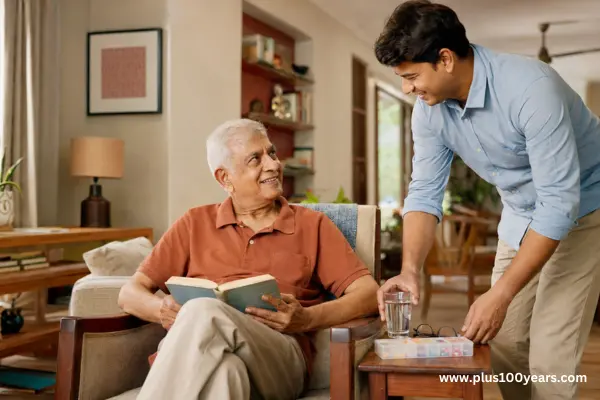
Helping is not about forcing water. We keep a glass or a small bottle near my grandmother where she can reach it easily, so she does not have to get up every time.
Water kept beside the bed at night also helps. These little senior hydration tips are things anyone can do at home without any trouble.
Water is not the only way to get fluids either. My grandmother takes soup, buttermilk, milk and fruits like watermelon and oranges, and all of these give water to the body too.
Giving fluids along with meals is easy, because everyone is sitting together anyway. Good water intake for seniors can come from food and drinks both, not only from plain water.
One thing I try to remember is to remind them gently and not like they are small children. I just drink my own water and softly ask them to take a few sips with me.
Nobody likes to be ordered, and older people also want to feel independent, so a kind reminder makes hydration for older adults feel normal and not like some medicine time.
How much water each person needs is not the same for everybody; it depends on their body size, food, activity, the weather, their medicines and their health.
Now when I think back to that hot afternoon with no electricity, I understand my grandfather better.
He was not being stubborn, and he was not wrong; his body just did not tell him he needed water.
These days, on such afternoons, I quietly keep a glass near him, and he sometimes drinks it slowly while watching television. He still says he is not thirsty, but now I know a gentle reminder is not a bad thing.
Author Bio
This article was prepared by the editorial team at Dvine H2O, an Indian water-technology company focused on water-quality education, filtration, alkaline ionisation and hydrogen-water systems.
The team translates technical water information into practical, evidence-conscious guidance for households.
Also Read :
Top 7 Traditional Indian Superfoods for a Healthy and Happy Life
Top 10 Best Home Remedies for Constipation
Indian breakfast for diabetes type 2